Game discovery has fundamentally changed. Most players now find new games while scrolling social feeds, watching short clips, or seeing content from creators they trust.
As of 2025, there are an estimated 5.24 billion people — roughly 63.9% of the global population, showing how massive these platforms are for reaching potential players.
For studios, social media is not about posting trailers and hoping they go viral — it’s about consistently showcasing real gameplay moments, community highlights, and creative stories that influence game installs.
Social platforms have become one of the primary discovery engines for gamers, with YouTube, TikTok, and Instagram driving conversations, trends, and visibility at scale.
In this guide, we break down powerful social media marketing tactics that help games attract the right players, build loyal communities, and sustain growth even in highly competitive genres.
Why Games Need Social Media Marketing Today?
Game marketing has become harder as app store visibility declines, and competition keeps increasing. Thousands of games launch every year, making organic discovery unreliable without external demand-generation channels like social media.
Today, social media is where players discover new games. Research shows that nearly 87% of gamers use social media daily, making these platforms critical for reaching active, engaged audiences.
Social platforms allow gaming studios to show real gameplay, live reactions, and authentic engagement, which influences install decisions more effectively than static screenshots or store-page trailers.
Here’s how social media directly supports game growth:
- Reach active gamers repeatedly where they already spend daily time.
- Showcase real gameplay moments that set accurate expectations.
- Build communities that drive trust, retention, and advocacy.
- Leverage creator-led discovery to influence install decisions.
Social media marketing also helps game publishers build continuous feedback loops, strengthen player loyalty, and turn engaged players into long-term brand advocates, which then increases the overall game popularity.
Now, let’s focus on some effective strategies of social media marketing for games that you can leverage today to grow in this intensely competitive market.
1. Choose the Right Social Platform for Your Game
Not every social platform works for every game. Choosing the wrong channels can waste your entire budget and resources. Today, gaming conversations dominate social media, generating over 15,000+ posts daily across major platforms, which shows better engagement and long-term growth.
In the list, YouTube remains central to each gaming content discovery, where 81% of gamers consume gaming-related content on YouTube, making it one of the strongest platforms for awareness and evaluation.
TikTok is also influencing game discovery rapidly, especially for short-form clips that spread virally among mobile gaming audiences.
Platform selection should always match your game’s genre, audience, and lifecycle stage, not only for trends. Here’s how to align platforms with game goals:
- Mobile and casual games perform best on TikTok and Instagram Reels.
- Mid-core and competitive games gain traction on YouTube and Twitter/X.
- Community-driven or live-service games need Discord for retention.
- Creator-heavy strategies scale faster on YouTube and TikTok.
When platforms aligns perfectly with player behavior, it can turn social media marketing into a high-growth organic channel.
2. Create Scroll-Stopping Gameplay Content
On social media, games get seconds to earn attention. Players decide whether a game is worth exploring based on how quickly the gameplay communicates fun, challenge, and reward.
Short gameplay clips outperform cinematic trailers because they show real mechanics, controls, and progression. Players want proof of experience, not as a very cool game.
According to TikTok research, ads and organic videos that show gameplay within the first three seconds see significantly higher watch-through and engagement rates. This reduces low-quality installs and attracts players who genuinely enjoy the game.
Content formats that consistently perform well for games include:
- Raw gameplay clips highlighting core mechanics.
- Short challenge moments, wins, or fails that trigger emotion.
- Before-and-after progression clips showing upgrades or growth.
- UI interactions that explain how the game feels to play.
Games that consistently publish gameplay-focused content build faster connection with players, improve install conversion, and strengthen their retention by attracting the right players.
3. Build Strong Gaming Communities
Most games fail not because of poor gameplay, but because players leave quietly. Communities solve this by giving players a reason to stay connected beyond the game session.
A gaming community acts as a retention layer. Players who interact with developers, moderators, or other players develop emotional attachment to the game. These community-engaged players are significantly more likely to return after updates, events, or seasonal changes compared to solo players.
Instead of treating social media as a broadcast channel, successful gaming studios use it as a feedback and interaction loop. Questions, polls, replies, and shared player content keep conversations alive.
Where communities create real impact:
- Retention improves when players feel seen and acknowledged.
- Updates gain faster adoption through community announcements.
- Player feedback helps fix issues before churn increases.
- Social proof grows when players share experiences organically.
Platforms like Discord enable real-time interaction, while Twitter/X and Instagram keep the wider audience informed and involved. Each platform plays a different role in the community lifecycle.
Games that invest in community building do not rely on constant paid acquisition. They grow through loyalty, advocacy, and sustained player relationships over time.
4. Collaborate with Gaming Influencers and Creators
Influencers can accelerate your game’s discovery by showing authentic play, reactions, and narratives across YouTube, Twitch, TikTok, and Instagram.
Choose micro-influencers for niche engagement and for scaling authenticity, and macro creators for mass awareness and creating buzz for your game. You can match any creator size according to campaign goals and expected ROI.
You can use multiple formats to promote through your influencers, such as:
- Live streams for deep engagement
- Sharing short clips for fast discovery
- Through sponsored reviews for credibility and
- Creating new creator challenges to spark UGC and virality.
Brands should also prioritize long-term partnerships with influencers over one-offs. These ongoing creator relationships will help you build familiarity, improve game popularity, and create compounding returns across launches and live ops.
5. Use Paid Social Media to Boost Growth
Organic reach on social platforms is limited. Paid social ads help games push content to specific audiences who are more likely to install and engage.
Paid social campaigns offer precise targeting, such as interests, behavior, demographics, and devices, to reach players who match your ideal profile.
For every $100 spent on mobile app ads, businesses not only receive paid installs but also around 3 additional organic installs, showing spillover into discoverability.
Paid installs can improve organic visibility, lifting overall store ranks and discoverability for games beyond just paid performance.
Best paid formats for games include:
- In-feed video ads for immediate engagement and installs.
- Playable ads that showcase mechanics before download.
- Story ads on Instagram and Facebook for immersive previews.
- TopView or In-Feed ads on TikTok for discovery and virality.
When executed thoughtfully, paid social campaigns can reduce dependency on broad paid installs, improve the quality of players, and accelerate growth trajectories.
6. Share Behind-the-Scenes and Developer Stories
Players do not connect with logos or ads. They connect with people.
Behind-the-scenes content humanizes the game and builds trust by showing the real effort behind development decisions.
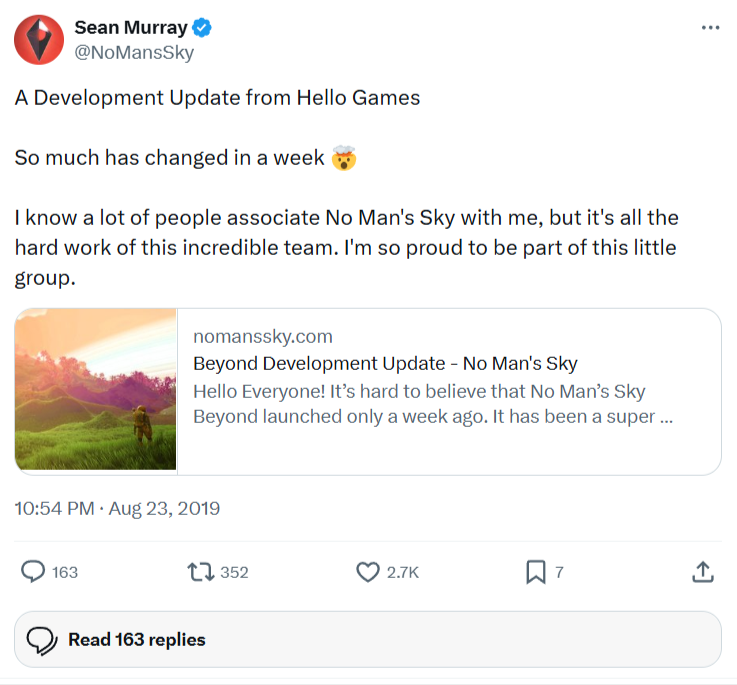
Hello Games used regular development updates, patch notes, and transparent roadmaps to revive No Man’s Sky and rebuild community trust.
(Source)
Behind-the-scenes content fills gaps between updates. Dev logs, art breakdowns, and prototype clips keep audiences engaged between releases.
When players feel emotionally connected to the team, they are more likely to support updates, forgive mistakes, and advocate for the game.
7. Encourage User-Generated Content
User-generated content can turn players into marketers. When players create clips, memes, or challenges, they promote the game in ways paid ads cannot replicate.
Fortnite’s Creative mode enabled players to design maps and share gameplay, driving massive organic visibility across TikTok, YouTube, and Twitter/X through community-led content.
UGC works because it feels authentic. Players trust other players more than brands when deciding whether a game is fun, competitive, or worth downloading.
Game studios can actively spark UGC by:
- Launching hashtag challenges tied to in-game moments.
- Featuring player clips on official social channels.
- Running creator contests with in-game rewards.
- Adding built-in sharing tools for clips and highlights.
When brands intentionally design systems for UGC, player participation increases, reach compounds organically, and communities grow without proportional marketing spend.
8. Align Social Media with Game Launches and Live Ops
Social media works best when it supports real moments in the game’s lifecycle, not when it runs as random posting. Games like Genshin Impact use social channels to prepare players for what’s coming next.
Teasers, countdowns, and early previews help players feel involved before updates go live.
During live operations, social media becomes a communication layer. It reminds players about events, highlights new content, and answers questions that appear after updates.
Studios should plan social content around key moments:
- Teasers before launches to spark curiosity.
- Gameplay clips on launch day to show what’s new.
- Short reminders during live events to pull players back in.
- Follow-up posts explaining changes players may miss.
When social media follows the game’s rhythm, players stay informed, feel included, and are less likely to drift away between updates.
Common Social Media Marketing Mistakes Gaming Studios Must Avoid
You’ve seen how social media can be leveraged to market games effectively. But many studios still misuse it. These mistakes often look small but quietly damage trust, reach, and player interest.
- Posting Without a Clear Content Purpose: Publishing content just to stay active leads nowhere. Every post should serve one main role, whether it’s about discovery, starting a conversation, or supporting an upcoming update.
- Over-Promoting Instead of Showing Gameplay: Constant install pushes make audiences scroll past. Players want to understand the gameplay experience before they are asked to commit their time or storage.
- Ignoring Community Interaction: Unanswered comments signal indifference. When players feel ignored, they stop engaging and eventually stop caring about future updates or announcements.
- Copying Trends Without Context: Trends borrowed blindly feel unnatural. If a format does not match the game’s mechanics or audience expectations, it confuses rather than attracts players.
- Being Present Everywhere Without Focus: Posting on every platform spreads teams thin. Strong results come from consistent execution on the platforms where the game naturally fits.
- Treating Creators as One-Time Promotions: Short-term creator deals feel transactional. Players can sense when enthusiasm is forced, which weakens credibility instead of building trust.
Social media works best when studios treat it as an ongoing conversation, not a checklist. The difference shows in how players respond, not just how often brands post.
Conclusion
Social media marketing for games now influences discovery more than listings. Players decide what to try based on what they see in feeds, clips, and creator content.
Games that grow on social media feel familiar before the download. Players understand the gameplay, which removes hesitation and builds confidence.
Gaming studios that treat social media as a conversation earn this attention naturally. They show progress, listen to feedback, and stay visible even when no major update is live.
If you want social media to actually support installs and growth, Bizzware helps game studios design strategies that feel native to platforms and natural to players. Contact us to get help from an expert today!