
Mobile game ads have become the primary way studios attract new players, promote launches, and scale growth in a market where visibility inside app stores alone is no longer enough.
Instead of waiting for organic discovery, developers now use paid advertising ecosystems to place games directly in front of users through videos, interactive demos, and in-app experiences.
Yet many teams invest in advertising without fully understanding how mobile game ads function, what formats perform best, or how costs and performance metrics actually work together.
This guide explains how mobile game ads work, available formats and platforms, market cost, and how to build campaigns that acquire players efficiently and sustainably.
Key Takeaways
Before you read it fully, here’s a snapshot of how successful gaming studios approach mobile game ads and why their campaigns outperform competitors:
- Mobile game ads work best when treated as a scalable acquisition system, placing interactive experiences where high-intent players already spend time rather than relying on passive discovery.
- High-performing studios prioritize ad formats that improve player quality, because rewarded videos and playable ads are only that typically drive stronger engagement, retention, and downstream monetization outcomes.
- Understanding pricing models early allows teams to control growth efficiently, since CPI, CPM, and CPA directly influence scaling decisions and long-term campaign sustainability.
- Advertising success rarely comes from budget size, but it comes from continuous targeting refinement, structured creative testing, and performance-driven optimization cycles.
- The most profitable campaigns measure retention, ROAS, and lifetime value (LTV) alongside installs, ensuring acquisition strategies support sustainable revenue instead of short-term growth spikes.
What is Mobile Game Advertising and How Does It Work?
Mobile game advertising are paid promotional placement designed to acquire players by showing game experiences inside other apps, social feeds, or gaming environments where potential users actively engage.
Instead of traditional advertising, these ads often simulate gameplay or reward interaction, allowing users to experience mechanics before installing, which significantly improves conversion intent and player quality.
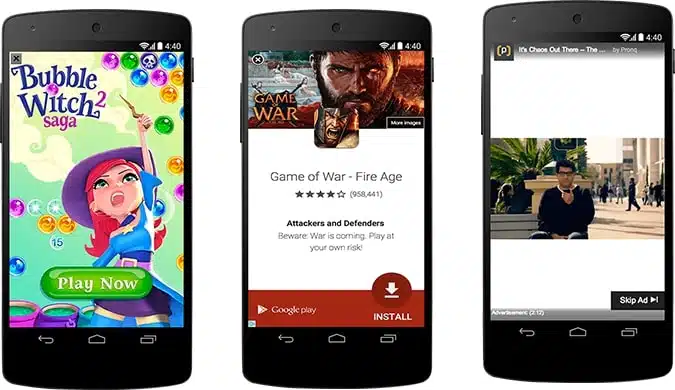
At a basic level, mobile game advertising operates through a performance ecosystem connecting four primary participants working together to deliver, optimize, and monetize ad impressions efficiently.
- Advertiser (Game Studio): Creates acquisition campaigns and defines targeting, budgets, and creatives designed to attract players likely to install, engage, and generate long-term revenue.
- Ad Network or DSP: Distributes ads programmatically across thousands of apps using automated bidding systems that match campaigns with users most likely to convert.
- Publisher App: Provides advertising inventory by displaying ads inside mobile apps, enabling monetization while giving advertisers access to active and highly engaged audiences.
- Player: Interacts with the advertisement, and their behavior, such as watching, clicking, or installing, determines campaign performance and optimization signals used by advertising algorithms.
Ad networks today use real-time bidding systems, where advertisers compete for impressions within milliseconds, allowing ads to be served dynamically based on behavior signals, device data, and conversion probability.
Programmatic advertising now powers most mobile game ads, enabling automated targeting and budget allocation. Because of this, performance advertising dominates mobile gaming because studios pay primarily for measurable outcomes such as installs or engagement, directly linking marketing spend to growth and revenue performance instead of visibility alone.
Types of Mobile Game Ad Formats
Choosing the right ad format directly influences install quality, engagement, and monetization outcomes. Each format serves a specific purpose depending on gameplay design, player motivation, and acquisition strategy.
Here are the top mobile game ad formats studios actively use to acquire players and monetize attention effectively across modern mobile advertising ecosystems.
1. Rewarded Video Ads
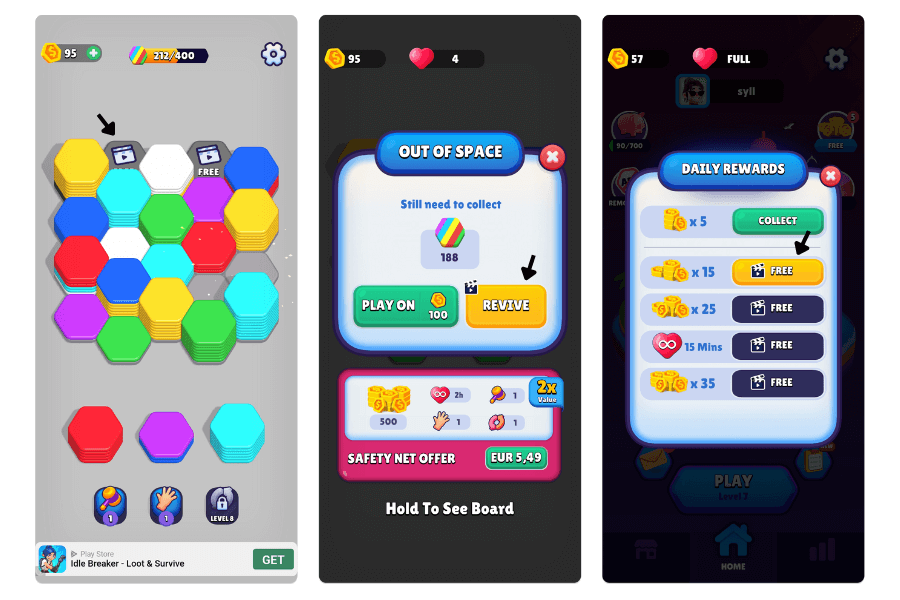
Rewarded video ads allow players to voluntarily watch advertisements in exchange for in-game rewards, creating positive engagement while maintaining player control over ad exposure and improving completion behavior.
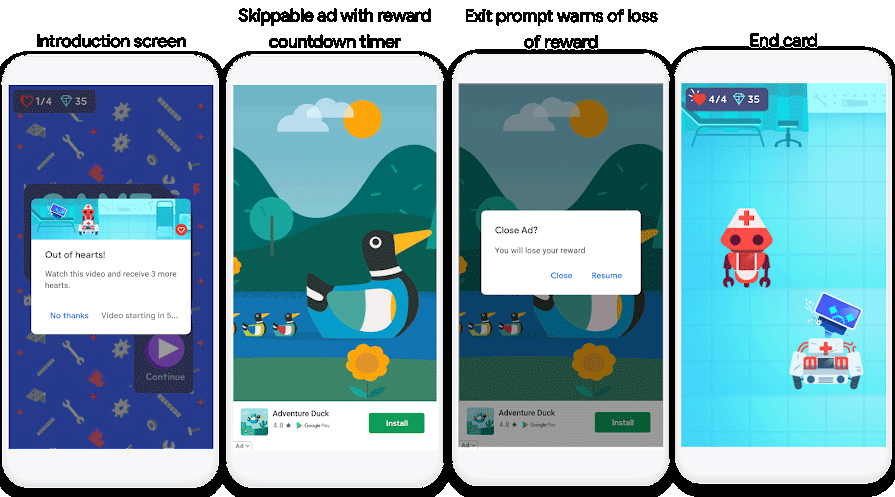
What makes rewarded ads powerful:
- Higher voluntary engagement compared to forced formats.
- Strong monetization from non-paying users.
- Improves session length and repeat gameplay behavior.
Rewarded videos regularly achieve 75.8% completion rates because users intentionally opt in, which directly improves advertiser ROI and player acceptance.
Best environments to use this ad format:
- Casual and mid-core games with repeat sessions.
- Games using boosters, energy systems, or progression rewards.
- Live-ops-driven games focused on retention loops.
2. Interstitial Ads
Interstitial ads appear between gameplay transitions, such as level completion or loading screens, capturing full attention moments where users naturally pause before continuing gameplay activities.
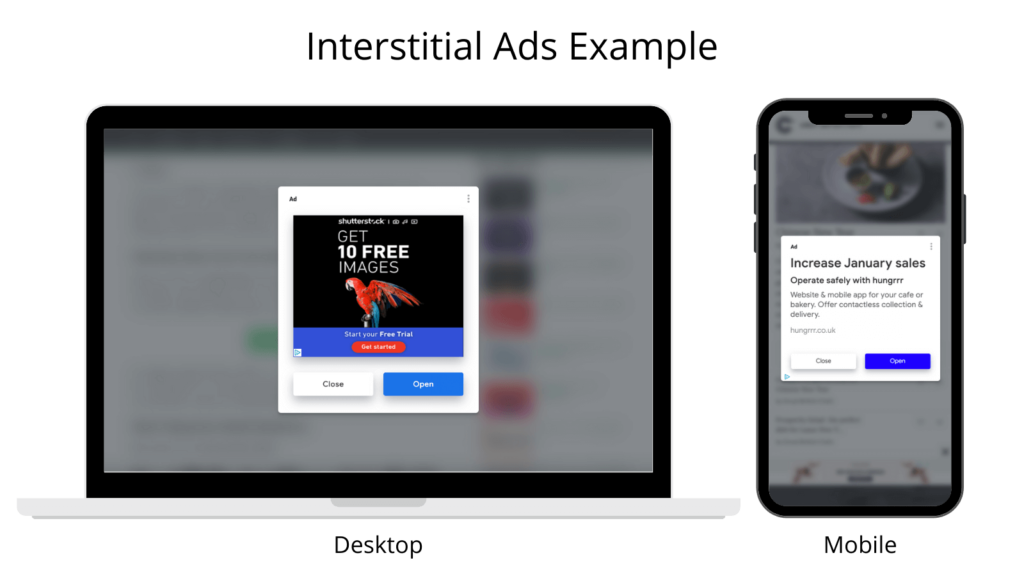
Why studios use interstitial placements:
- Full-screen visibility increases interaction probability.
- Simple implementation across multiple genres.
- An effective format for scaling install volume quickly.
Where interstitials work best:
- Between levels or match results.
- During natural gameplay pauses.
- Never during active gameplay control.
3. Playable Ads
Playable ads provide a short interactive gameplay demo before installation, helping players experience mechanics firsthand and filtering installs toward users already interested in the gameplay loop.
Strategic advantages of playable ads:
- Pre-qualifies users before downloading.
- Reduces uninstall rates after install.
- Improves engagement quality from acquired users.
Retention rates can improve by roughly 30–40% when users are acquired through playable ads because players understand gameplay expectations before installing.
4. Banner Ads

Banner ads are persistent placements displayed at screen edges during gameplay, offering lightweight monetization without interrupting player sessions or forcing interaction.
Why banner ads still exist:
- Continuous passive monetization.
- Low development complexity.
- Supports revenue at scale with large DAU bases.
Mobile banner click-through rates usually range between 0.08% and 0.12%, which limits acquisition efficiency but supports background monetization strategies.
Best suited for:
- Hyper-casual or idle games.
- High-traffic titles with frequent sessions.
- Secondary monetization alongside rewarded ads.
5. Native Ads
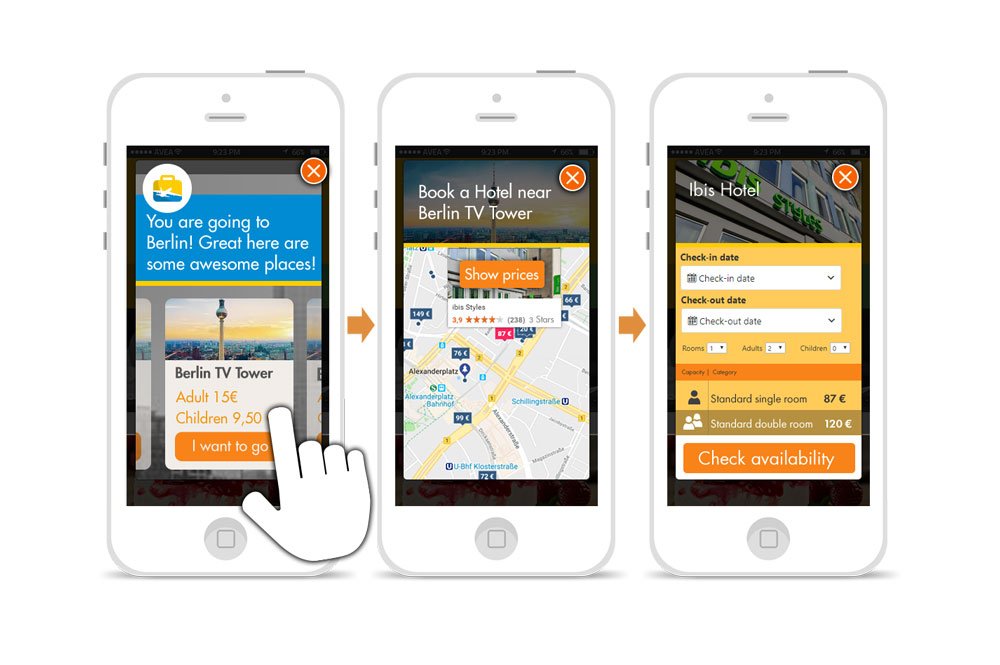
Native ads blend directly into app interfaces by matching surrounding design elements, reducing disruption while maintaining visibility and improving attention compared to traditional display advertising formats.
Advantages for player experience:
- Feels integrated into UI flow.
- Lower ad fatigue compared to banners.
- Higher attention without interrupting gameplay.
Effective placements for using native ads:
- Game menus or store sections.
- Discovery feeds.
- Non-gameplay navigation environments.
6. Offerwall Ads
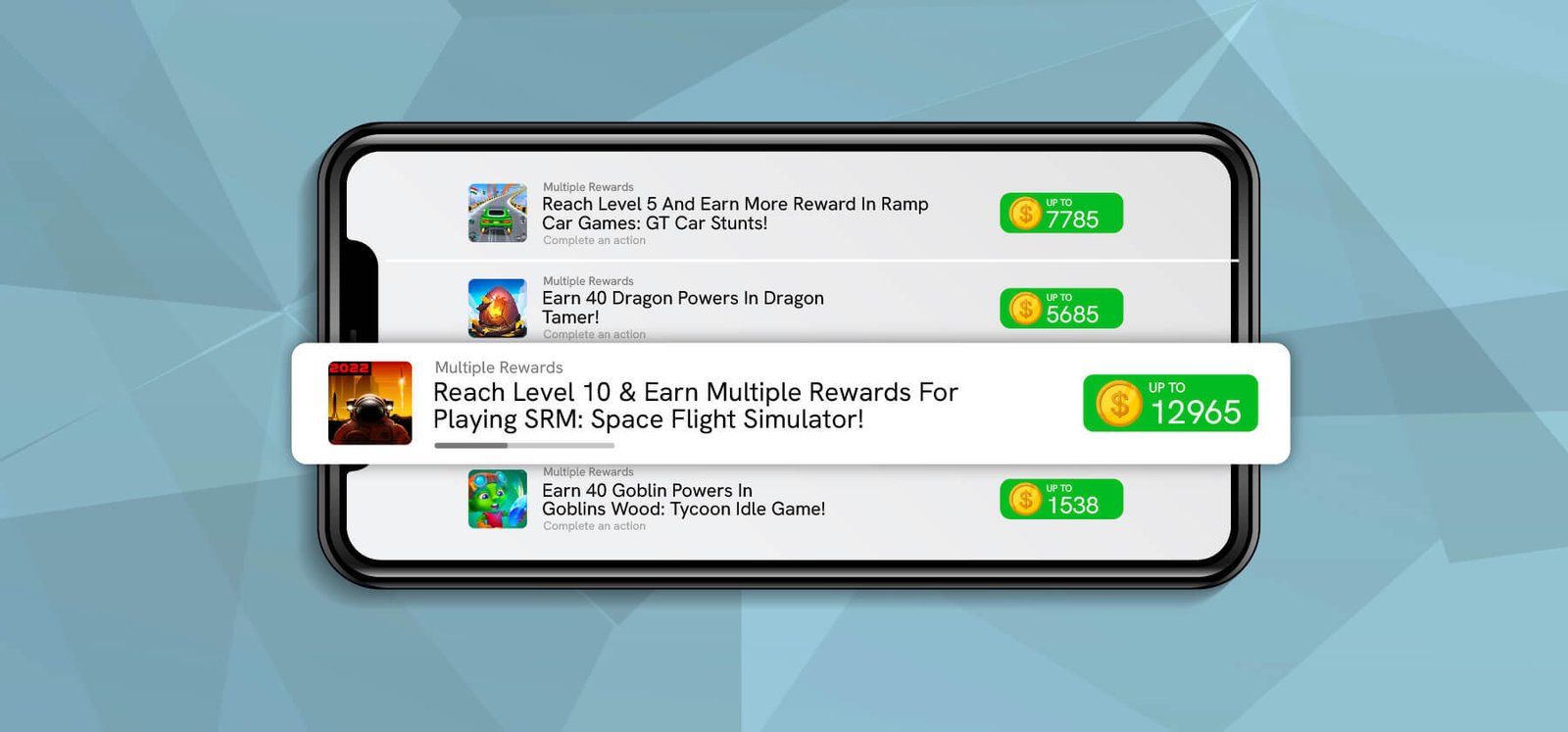
Offerwalls present players with multiple reward-based tasks such as installing apps or completing actions, attracting highly motivated users willing to exchange effort for premium in-game rewards.
Why studios deploy offerwalls:
- High monetization potential from engaged users.
- Encourages deeper interaction with reward systems.
- Extends revenue beyond standard ad viewing.
Offerwalls can generate extremely high eCPMs, sometimes exceeding $400 in premium markets, making them one of the highest-earning monetization formats in mobile games.
Best implementation areas:
- Free-to-play economies.
- Games with premium currencies.
- Long-session engagement loops.
Top Platforms To Run Mobile Game Ads
Mobile game advertising performance changes depending on where campaigns run because every platform attracts different player intent, discovery behavior, and conversion readiness across the acquisition funnel.
Here are the top mobile ad platforms studios use to run mobile game ads strategically:
1. Meta Ads (Facebook and Instagram)
Meta functions as a performance scaling engine where machine learning analyzes behavioral signals, purchase patterns, and engagement history to find users statistically more likely to install and monetize.
Why studios allocate large budgets here:
- Advanced lookalike modeling expands winning audiences.
- Event optimization improves ROAS over time.
- Strong performance across multiple geographies.
Meta becomes most effective after creative validation, allowing studios to transition from the testing phase into predictable scaling supported by conversion data and algorithm learning stability.
2. Google App Campaigns (UAC)
Google App Campaigns distribute ads across Search, YouTube, Play Store, and Display inventory, capturing both discovery traffic and users actively searching for new games to install.
Strategic value for game marketers using Google App campaigns:
- Search captures high-intent players.
- YouTube supports gameplay discovery.
- Automated bidding reduces manual optimization workload.
Paid acquisition research shows install advertising also drives incremental organic installs, with ad spend generating additional unpaid downloads through cross-platform discovery effects.
3. TikTok Ads
TikTok operates as a creative-first acquisition channel where gameplay moments, visual hooks, and rapid storytelling drive discovery before players actively begin searching for games.
Why gaming studios prioritize TikTok testing:
- Fast creative feedback cycles.
- Algorithm rewards engaging gameplay visuals.
- Strong discovery among younger gaming audiences.
Gaming content engagement on TikTok commonly ranges between 4% and 8%, significantly higher than traditional social platforms, accelerating creative testing and early campaign learning speed.
4. Unity Ads
Unity Ads places advertisements directly inside other mobile games, allowing studios to reach users already familiar with gameplay loops and in-app advertising environments.
Key acquisition advantages:
- Gaming-native audiences improve install intent.
- Rewarded placements increase engagement.
- Contextual targeting inside gameplay sessions.
Studios often use Unity Ads when optimizing for player quality rather than raw volume because traffic originates from active gaming environments instead of general social feeds.
5. ironSource (LevelPlay)
ironSource connects monetization mediation with acquisition tools, allowing studios to evaluate user acquisition performance alongside in-game revenue signals within a single operational ecosystem.
Why advanced studios rely on mediation platforms:
- Unified acquisition and revenue insights.
- Access to multiple ad demand sources.
- Better optimization between growth and monetization.
This approach helps live-ops games adjust acquisition budgets based on actual player value rather than install metrics alone, improving long-term profitability decisions.
6. Apple Search Ads
Apple Search Ads target users directly inside App Store search results, capturing players during high-intent moments when they are already looking for games to download.
Search-result campaigns achieve conversion rates around 55% to 67%, meaning more than half of users who tap an ad proceed to install, making it one of the highest-intent channels available.
How Much Do Mobile Game Ads Cost?
Understanding mobile game advertising costs helps you plan acquisition realistically, because budgets fail most often when teams scale campaigns without knowing expected CPI ranges, bidding models, or regional pricing differences.
Mobile game ads are usually priced using performance models, which means advertisers pay based on installs, impressions, or actions instead of visibility alone, making cost directly tied to measurable outcomes.
But before you know how much it costs, you first need to understand their most common pricing models used in mobile game advertising, which include:
- CPI (Cost Per Install): You pay only when a user installs the game, making it the dominant pricing model for user acquisition campaigns focused on measurable growth.
- CPM (Cost Per Mille): Advertisers pay per thousand impressions, commonly used for awareness campaigns or monetization placements where reach matters more than direct installs.
- CPA (Cost Per Action): Payment occurs only after a defined action, such as registration, tutorial completion, or purchase, helping studios optimize toward deeper funnel performance rather than installs alone.
Real acquisition costs vary widely depending on platform, region, and genre, which is why comparing campaigns without context often leads to unrealistic performance expectations and incorrect scaling decisions.
According to Business of Apps, current mobile game CPI benchmarks show:
- iOS game installs typically range between $2 and $5.
- Android game installs usually fall between $1.5 and $4, depending on targeting and competition intensity.
Genre also changes acquisition economics significantly. Strategy and RPG games often exceed $5 CPI because competition for high-value players increases bidding pressure across advertising auctions.
Now, here are some regional pricing differences that strongly influence budgets:
- North America averages roughly $2.5 to $5 CPI.
- APAC markets commonly range between $1.5 to $3.
- Latin America can drop as low as $0.50 to $2 per install.
Studios optimizing only for cheaper installs often struggle later, because lower CPI regions may produce weaker monetization unless retention and lifetime value align with acquisition strategy.
Therefore, a genuine budgeting approach can be used by growth teams to validate retention metrics first at smaller spend levels, then scaling only when LTV consistently exceeds acquisition cost thresholds.
Best Targeting Strategies for Mobile Game Advertising
Below are the targeting approaches most consistently used in successful mobile game advertising campaigns today:
1. Lookalike Audience Targeting
Lookalike targeting identifies new users who behave similarly to existing high-value players, allowing platforms to expand reach while maintaining behavioral alignment with proven monetizing audience segments.
Why it works in gaming acquisition:
- Expands scale without losing player quality.
- Uses real behavioral data instead of assumptions.
- Improves conversion probability during scaling.
Lookalike audiences built from retargeting pools convert about 45% better than cold audiences because algorithms replicate traits from users already demonstrating strong engagement patterns.
2. Behavioral and Interest-Based Targeting
Behavioral targeting focuses on users’ past actions, such as game installs, genre engagement, spending patterns, and session behavior.
Advantages of using this ad strategy:
- Reduces wasted impressions.
- Improves early retention signals.
- Aligns acquisition with player intent.
Modern gaming UA strategies rely heavily on behavioral signals because engagement depth now predicts revenue more accurately than demographic targeting alone across most mobile advertising ecosystems.
3. Retargeting and Re-Engagement Campaigns
Retargeting focuses on users who previously interacted with ads or installed the game but stopped engaging, bringing them back using personalized creatives and progression-based messaging.
Why retargeting drives strong ROI:
- Targets users already familiar with the game.
- Shortens conversion decision cycles.
- Improves monetization recovery rates.
Retargeting campaigns can improve conversion rates by 30% to 80%, while mobile app retargeting overall increases conversion performance by roughly 38% compared to cold acquisition campaigns.
4. Contextual and In-Game Targeting
Contextual targeting delivers ads inside games with similar mechanics or genres, ensuring advertisements appear within relevant gameplay environments where player intent already exists.
Where contextual targeting excels:
- Strategy games are promoted inside strategy titles.
- Puzzle games are advertised within casual ecosystems.
- Higher install intent due to gameplay familiarity.
This advertising strategy is perfectly good to use for higher engagement quality, as players already have active gaming behavior rather than passive social media browsing patterns.
5. First-Party Data and Predictive Targeting
With privacy changes limiting third-party tracking, gaming publishers increasingly rely on first-party data, such as in-game behavior, progression events, and purchase signals, to guide acquisition optimization.
Why this approach matters now:
- Improves targeting accuracy post-IDFA.
- Enables predictive lifetime value modeling.
- Strengthens long-term campaign stability.
Mobile Game Ads KPIs: Tracking Performance & Growth
Running mobile game ads without tracking the right KPIs can lead to misleading growth, because installs alone rarely indicate profitability, retention strength, or long-term player value generated from campaigns.
Below are the core KPIs growth teams monitor when running mobile game advertising campaigns:
1. Cost Per Install (CPI)
CPI measures how much advertising budget is required to acquire one player, making it the first signal showing whether targeting, creatives, and platform selection are financially efficient.
Mobile game CPI typically ranges between $2 and $6, depending on genre, competition intensity, and geography, with higher-monetizing genres often accepting higher acquisition costs for stronger lifetime value.
2. Retention Rate
Retention shows how many players return after installing, directly indicating whether acquired users actually enjoy gameplay or leave before monetization systems begin working effectively.
Average mobile game retention benchmarks show roughly 27–30% Day-1 retention, around 8–13% by Day-7, and near 5% or lower by Day-30 across most gaming categories.
3. Return on Ad Spend (ROAS)
ROAS directly measures revenue generated for every dollar spent on advertising, helping studios understand whether campaigns recover acquisition costs and produce scalable profit instead of short-term install growth.
Many mobile game campaigns target approximately 3:1 ROAS, which means that for every $1 spent on advertising, it should ideally generate $3 in revenue to sustain long-term user acquisition scaling.
4. Lifetime Value (LTV) vs Customer Acquisition Cost (CAC)
LTV estimates total revenue generated by a player during their entire lifecycle, while CAC represents acquisition cost, and profitable growth occurs only when lifetime value consistently exceeds acquisition spending.
5. Install-to-Engagement Rate
This KPI tracks how many acquired users begin meaningful gameplay actions such as completing tutorials or early levels, revealing whether ads attract curious installers or genuinely interested players.
Low engagement rates often signal a creative mismatch, where advertisements promise experiences different from actual gameplay, causing rapid churn despite strong install performance metrics.
By effectively tracking the right mobile game advertising KPIs, you can transform from experimental spending into measurable growth systems built around retention, monetization, and longer player values.
Common Mistakes in Mobile Game Advertising
Many mobile game ad campaigns fail not because of low budgets, but because strategic errors compound early and damage retention, monetization, and algorithm learning stability.
Below are high-impact mistakes that repeatedly limit campaign performance across mobile game advertising ecosystems.
1. Scaling Before Validating Retention
Studios often increase spend immediately after seeing low CPI, ignoring Day 1 and Day 7 retention signals that ultimately determine whether acquired users generate long-term revenue or not.
Average Day 1 retention across mobile games ranges between 25% to 35%, meaning aggressive scaling without retention validation amplifies unprofitable acquisition at larger budget levels.
2. Optimizing Only for Installs
Focusing exclusively on install volume encourages platforms to deliver cheaper users who convert initially but churn quickly, reducing ROAS and damaging long-term campaign sustainability.
Instead, game publishers should optimize towards in-app events such as tutorial completion or first purchase, which often achieve stronger monetization efficiency than install-only optimization strategies.
3. Ignoring Creative Fatigue
Repeatedly showing the same creative increases ad frequency, which reduces click-through rates, and forces bidding systems to pay more for diminishing performance returns.
Rising ad frequency directly correlates with declining engagement, making structured creative refresh cycles essential for maintaining stable acquisition costs.
4. Over-Targeting Narrow Audiences
Excessively tight targeting restricts algorithm learning and limits scale potential, especially during early campaign stages when data signals remain statistically insufficient.
Modern ad platforms perform better when given broader audience signals combined with conversion optimization, allowing machine learning systems to identify profitable subsegments dynamically.
5. Misaligned Store Page Experience
If you’re driving traffic to poorly optimized store listings, it’ll automatically reduce conversion rates, increasing effective CPI and undermining otherwise strong creative or targeting performance.
So, you should be focusing on improved screenshots and localized messaging to increase conversion rates significantly, directly reducing acquisition cost per effective install.
6. Neglecting Payback Period Analysis
Running campaigns without payback benchmarks leads to premature shutdowns or excessive scaling before revenue data matures across lifecycle cohorts.
You must calculate 30-day, 60-day, or 90-day payback windows to align acquisition budgets with realistic monetization timelines instead of reacting emotionally to early data.
Avoiding these mistakes can help mobile game publishers to invest in the right advertising channel as well as implementing right strategies to make sustainable mobile game growth.
Future Trends in Mobile Game Advertising (2026 Outlook)
The following trends explain how mobile game ads are evolving and what studios must prepare for to remain competitive over the next phase of growth.
1. AI-Driven Campaign Automation
Advertising platforms are rapidly moving towards AI-managed campaigns where creatives, audience targeting, and optimization decisions are generated automatically using performance data and behavioral prediction models.
Nearly 75% of marketers already use AI to create advertising media, while automation continues expanding across bidding, creative testing, and personalization workflows inside major ad platforms.
2. Retention-Led User Acquisition
Games are shifting budgets away from install volume towards retention and lifetime value metrics, prioritizing players who monetize over time rather than short-term acquisition spikes.
Remarketing spend reached $31.3 billion in 2025, growing 37% year-over-year, showing how re-engagement campaigns are becoming a central pillar of mobile advertising strategies.
3. Interactive and Video-First Ad Experiences
Mobile advertising is increasingly dominated by video and interactive formats such as playable ads, rewarded experiences, and immersive creatives designed to simulate gameplay before installation.
Mobile video advertising alone is projected to reach approximately $19.39 billion in 2026, reflecting strong industry movement toward engagement-driven acquisition rather than static display formats.
4. Privacy-First Targeting Models
Privacy changes across iOS and Android ecosystems continued reducing third-party tracking, forcing advertisers to rely more heavily on contextual signals, first-party data, and predictive modeling approaches.
Modern mobile advertising strategies now focus on aggregated performance signals instead of user-level tracking, reshaping how attribution, optimization, and measurement operate across campaigns.
5. Programmatic and In-App Advertising Expansion
In-app advertising have continue gaining budget share because gaming audiences demonstrate higher engagement compared to mobile web traffic, improving conversion probability and monetization outcomes.
6. AI-Generated Creative Personalization
Today, advertising creatives are moving towards dynamic generation where platforms automatically produce multiple variations tailored to user behavior, geography, and engagement history in real time.
Major platforms are already testing fully automated ad creation systems capable of generating visuals, messaging, and targeting simultaneously, reducing manual creative production dependency.
Including all these future mobile game advertising will reward studios, moreover, to combine strong product analytics, creative experimentation, and AI-assisted optimization rather than relying purely on budget expansion alone.
Conclusion
Mobile game ads have evolved more into a performance-driven growth where success depends on strategic format selection, precise targeting, retention-focused optimization, and continuous measurement rather than aggressive spending.
Studios that understand how platforms, pricing models, creatives, and KPIs work together gain a measurable advantage, acquiring players who engage longer and generate sustainable revenue across lifecycle stages.
The most effective campaigns no longer chase installs blindly. They equally prioritize:
- Player quality
- Retention
- Aligned acquisition costs
- Consistent lifetime value and more.
Even as advertising ecosystems become increasingly automated, you must combine analytics, creative experimentation, and structured testing frameworks to outperform competitors rather than relying on outdated acquisition approaches.
If you want to scale mobile game ads with a strategy built around profitability instead of guesswork, contact Bizzware and get expert support to grow your game sustainably.