
Mobile game monetization is no longer just about inserting ads into gameplay. It is about placing the right ads through the right platform at the right moment in the player journey.
In 2026, Unity Ads and AdMob stand out as the two most widely used ad networks in mobile gaming. Both are powerful, both are trusted, but they are built with different priorities and perform differently depending on your game type and audience.
The platform you choose directly impacts more than just revenue. It shapes player experience, retention, and long-term engagement. A poor choice can quietly reduce both earnings and active users over time.
If you look at data, global mobile ad spending is expected to cross $430 billion in 2026, with a major share flowing through in-app advertising ecosystems.
Therefore, deciding between Unity Ads vs AdMob is as critical as building a great game. This blog is a clear comparison to help you choose the right monetization platform for your game, so you don’t miss what’s important for your growth.
What is Unity Ads?
Unity Ads is Unity Technologies’ ad monetization platform built specifically for games. It works best for developers who already build on the Unity engine, because integration is usually direct and fast.
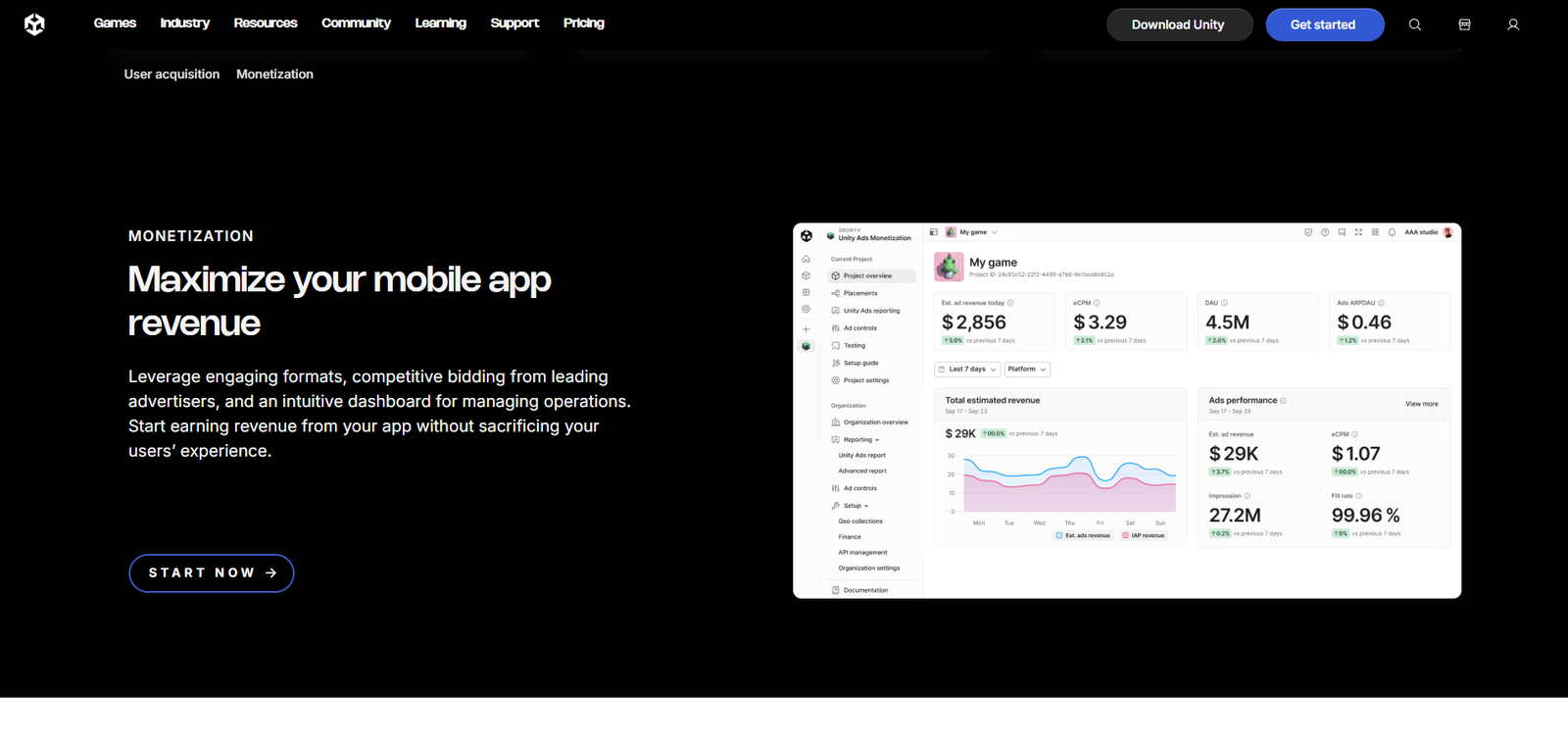
Its strongest use case is rewarded video. That matters because rewarded ads fit naturally inside gameplay without hurting the user experience as much as forced placements.
Unity’s 2024 Gaming Report showed in-app advertising revenue growth of 26.7% year over year, based on data from about 5 million Unity Engine developers and more than 342 billion ad views. That tells you the platform is still driving real results for game publishers.
What Unity Ads is built for:
- Game-first design: The platform is built around game monetization, not general app advertising.
- Rewarded video focus: Players choose to watch ads in exchange for rewards, which usually supports better engagement.
- Simple Unity integration: Developers using Unity can implement it with less setup friction.
- Gaming-specific demand: The ad inventory is mostly game-related, which can improve relevance and completion rates.
Unity Ads is not trying to serve every app category, and that is one reason it remains useful for game monetization.
What is Google AdMob?
Google AdMob is Google’s mobile ad platform for apps and games. Its main advantage is reach. It connects publishers to Google’s large advertiser base, which helps drive strong fill rates across many markets.
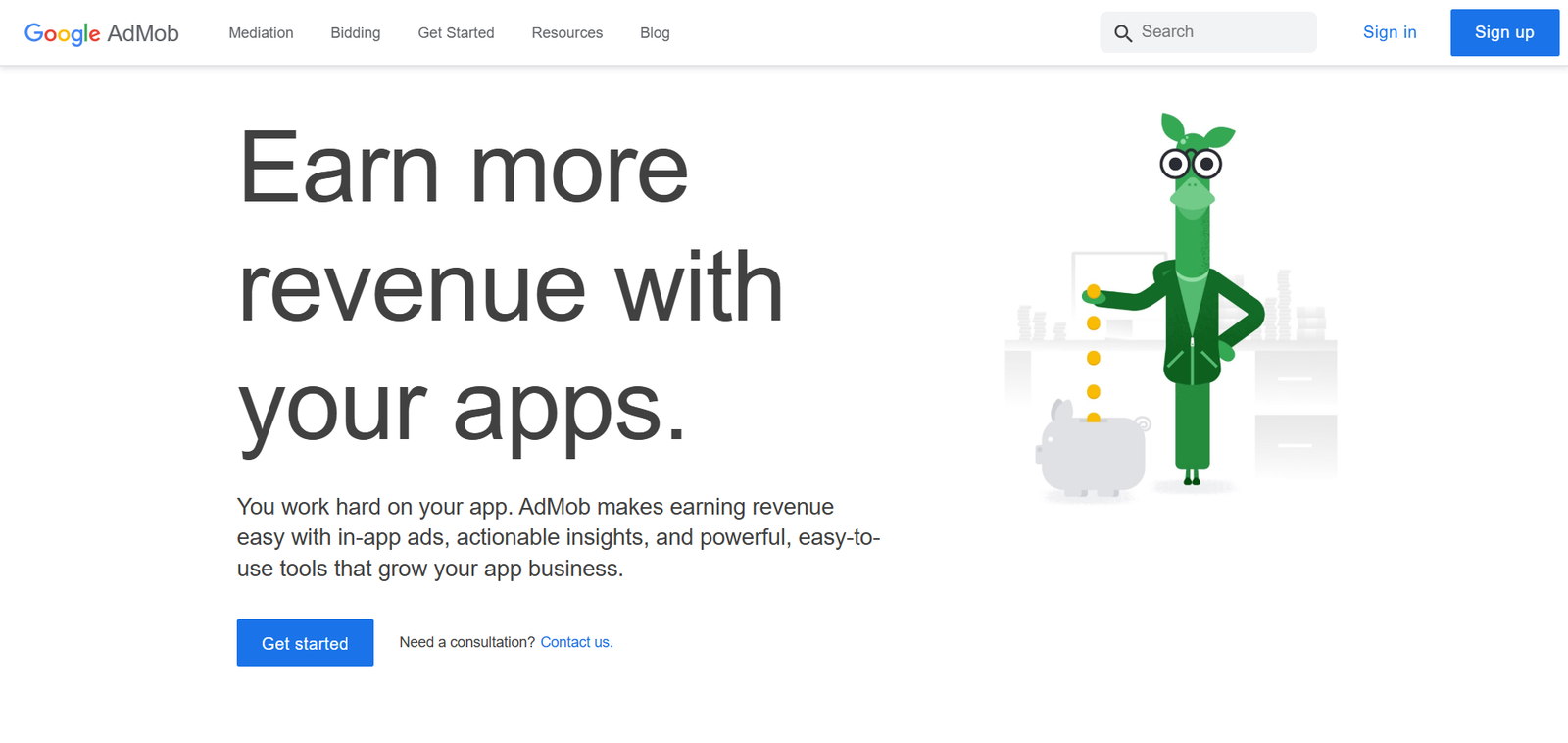
Unlike Unity Ads, AdMob is not limited to games. It works across utilities, entertainment apps, tools, and mobile games. That makes it more flexible, especially for publishers who want one network across different app types.
Google’s ad business generated $264.19 billion in revenue in 2024, and AdMob benefits from that wider advertiser ecosystem. More demand usually means better competition for your inventory.
Here is what AdMob offers:
| Feature | What It Means for You |
| Google Ad Network | Large demand pool and strong fill rates |
| Multi-format support | Banners, interstitials, rewarded video, and native ads all in one SDK |
| Firebase integration | Better tracking and audience insights |
| Cross-platform SDK | Works across Android, iOS, Unity, and other engines |
| Built-in mediation | Lets you combine demand from multiple ad networks |
For developers who want broad reach, stable monetization, and flexibility beyond game-only ad demand, AdMob is often the stronger default choice. It remains one of the most practical options for mobile game ads monetization in 2026.
Unity Ads vs AdMob — Key Differences You Need to Know
Both platforms monetize mobile games. But how they do it, who they serve best, and where they perform is totally different.
Before you pick one, here is a side-by-side view of where they stand:
| Factor | Unity Ads (LevelPlay) | Google AdMob |
| Primary Focus | Mobile Games (High-intensity optimization) | Broad Spectrum (Apps, utilities, and games) |
| Best Ad Format | Rewarded Video & Playables | Banners, Interstitials, & Native |
| Integration | Native Unity engine (Single-click setup) | Cross-platform SDK (Android, iOS, Flutter, etc.) |
| Advertiser Pool | Gaming-centric (User acquisition for other games) | Universal (Google Ads & Search ecosystem) |
| Fill Rate Strength | Strongest in Tier-1 gaming markets | Industry-best globally (Near 100% in all tiers) |
| Mediation | Unity LevelPlay (Advanced bidding) | Google Ad Manager |
| Payment Cycle | Net 60 (60 days after month-end) | Monthly (~21st of month at $100 threshold) |
Now, let’s check each and see what matters the most.
1. Unity Ads vs AdMob: Platform Focus and Ecosystem
This is the most important difference in the Unity Ads vs AdMob comparison because it shapes how both platforms perform in real game monetization setups.
Unity Ads is built specifically for game monetization, and its entire ecosystem reflects that focus. The advertiser base mainly includes game studios, mobile publishers, and brands targeting active gamers. This is why the ads shown inside games are usually highly relevant, often other games, in-game offers, or gaming-related promotions. Since everything sits inside a gaming-first environment, the targeting feels naturally aligned with how players behave inside games.
According to a 2025 mobile gaming report analyzing the top 1,000 revenue-generating mobile games, Unity Ads had an adoption rate of 69% in 2024, while AdMob stood at 56%.
That level of adoption shows how strongly game studios rely on Unity Ads when gaming is the core focus of their product.
AdMob works differently because it is powered by Google’s full advertiser ecosystem. It includes brands from almost every industry, covering different budgets, categories, and regions. This creates a much larger pool of advertisers competing for your inventory, which helps in scaling monetization across global audiences.
Since AdMob is not gaming-specific, players may sometimes see ads like insurance offers or food delivery apps inside games, which can feel less aligned with the gameplay experience compared to Unity Ads.
In simple terms, Unity Ads fits better when your audience is primarily gamers, and your focus is on in-game engagement. AdMob works better when you want a broader advertiser reach across multiple regions and user types.
Also Read: User Acquisition for Mobile Games: Importance, Strategies & How To Do It Right?
2. Ease of Integration and Setup on Unity Ads and AdMob
For Unity developers, this is one of the clearest differences between the two platforms and often a deciding factor in early setup choices.
Unity Ads integrates directly through the Unity Package Manager as a native package. You simply install it, configure your ad placements, and you are ready to go live. There is no separate SDK download, no extra build configuration, and no complex compatibility handling. Developers working inside Unity usually describe this as one of the most straightforward ad integrations available.
AdMob follows a different setup path. It requires the Google Mobile Ads SDK to be added separately into your project. For Unity games, Google provides a dedicated plugin, but it still introduces additional setup steps compared to Unity Ads. For native Android or iOS apps, AdMob is well supported and widely documented, but it still involves more manual integration work than a native Unity package.
Here is how both platforms compare in real integration flow:
- Unity Ads: Native install through Unity Package Manager, no external SDK dependency, fastest setup experience for Unity-based games, minimal configuration needed to start monetizing.
- AdMob: Separate SDK installation, additional configuration steps for Unity projects, stronger flexibility for Android and iOS native apps, and non-Unity engines.
- Documentation: Both platforms provide solid documentation, but Unity Ads is more directly focused on in-game implementation scenarios within Unity workflows.
- Mediation setup: AdMob offers more mature mediation through Google Ad Manager, while Unity LevelPlay provides similar capabilities but usually requires more configuration effort to optimize properly.
If your game is built in Unity, Unity Ads gives you a faster path to monetization with fewer setup steps. If you are working across multiple engines or need broader platform flexibility, AdMob offers more versatility at the cost of slightly higher integration effort.
3. Unity Ads vs AdMob: Fill Rates and Global Reach
Fill rate is one of those metrics most developers ignore until they see it with unfilled impressions in their dashboard. Every missed ad request is a direct revenue loss that never gets recovered.
This is where AdMob has a clear structural advantage. Its global advertiser network helps maintain consistently high fill rates, often above 95% for rewarded ad requests in strong-performing regions. Even when demand drops in certain markets, Google’s ecosystem helps stabilize performance instead of letting revenue fall sharply.
Unity Ads performs well, but its strength is more concentrated in specific gaming-heavy regions. Markets like the United States, United Kingdom, Germany, and Japan usually show stronger and more stable fill performance because gaming advertiser demand is high there.
However, in tier-2 and tier-3 regions, Unity Ads fill rates can become less consistent. This happens because its advertiser base is heavily gaming-focused, and gaming ad demand is not evenly distributed across all geographies.
Here is how the regional performance difference typically plays out:
- Tier 1 regions: Both Unity Ads and AdMob perform strongly, with stable fill rates and higher eCPMs.
- Tier 2 regions: AdMob usually maintains more consistent fill due to broader advertiser demand.
- Tier 3 regions: AdMob has a clear advantage because of deeper global advertiser coverage.
If most of your players come from North America or Western Europe, Unity Ads is usually sufficient for maintaining strong fill rates. If your traffic is spread across Southeast Asia, Latin America, or Eastern Europe, AdMob provides more stable monetization because of its wider advertiser distribution.
4. AdMob vs Unity Ads Revenue — eCPM Trends and What to Expect?
Here is a verified eCPM comparison across key formats for tier-1 traffic based on 2024 and 2025 benchmark data:
| Ad Format | AdMob eCPM | Unity Ads eCPM | Winner / Advantage |
| Banner Ads | $0.50 – $2.10 | $0.20 – $0.80 | AdMob (Better global demand) |
| Interstitial Ads | $6.00 – $12.00 | $8.00 – $18.00 | Unity (Higher engagement playables) |
| Rewarded Video | $18.00 – $45.00 | $15.00 – $30.00 | AdMob (Massive Google/Retail spend) |
AdMob leads on banners and rewarded video eCPMs consistently for tier-1 traffic. AdMob rewarded video eCPMs average around $16 for iOS and $12 for Android in tier-1 markets, reaching as high as $22 for Japan iOS.
Unity Ads competes well on interstitials for gaming audiences and can outperform on rewarded video when the player base is deeply engaged, because gaming advertisers pay a premium for high-intent gaming traffic specifically.
But in deciding eCPM, geography matters the most. An app with 80% tier-1 traffic generates roughly 3x the revenue of an identical app with 20% tier-1 traffic, regardless of which platform you are on. Know your audience geography before obsessing over the unity ads vs admob revenue debate, because that single factor influences eCPMs more than your network choice.
For most studios in 2026, the smarter approach is not choosing one and hoping for the best. Publishers running mediation strategies typically achieve 40 to 60% higher revenue than single-platform implementations. Running both through a mediation layer and letting live bidding data decide which network wins each impression is how serious studios are actually building their monetization strategies today.
Ad Formats Comparison — What Unity Ads and AdMob Actually Support?
Ad format support is not just a feature checklist. It directly determines how you can monetize, where you can place ads, and how much each impression can realistically earn.
Here is exactly what each platform supports:
| Ad Format | Unity Ads (LevelPlay) | Google AdMob |
| Rewarded Video | Yes, core format | Yes, core format |
| Interstitial | Yes | Yes |
| Banner | Yes | Yes |
| Native Ads | Yes (Supported via Bidding) | Yes, fully supported |
| Playable Ads | Yes, industry leader | No (Directly), limited via HTML5 |
| Rewarded Interstitial | No (Limited/Custom) | Yes |
| App Open Ads | No | Yes |
The honest takeaway: AdMob gives you more formats to work with. Unity Ads gives you fewer formats but optimizes the gaming-specific ones more deeply. If your entire revenue strategy runs on rewarded video and interstitials, Unity Ads is more than enough. If you want to layer in native placements, app open ads, or rewarded interstitials, AdMob is the only option here.
AdMob vs Unity Ads Revenue: Which Platform Pays More in 2026?
There is no clean winner in this comparison. Revenue depends mainly on three factors:
- Ad format
- User geography and
- Game type.
Everything else is apart from this is secondary.
Here is what current data shows:
Rewarded video ads in the United States average around $16.49 eCPM on Android and $19.63 on iOS. These numbers apply to both Unity Ads and AdMob for tier-1 traffic, but AdMob usually performs stronger outside the US because of its larger advertiser base and higher fill consistency across regions.
Unity Ads performs strongly in rewarded video for gaming-focused audiences. In tier-1 markets, Unity Ads rewarded eCPMs typically sit between $10 and $12. On paper, this is lower than AdMob, but the difference reduces when traffic is highly engaged and comes from users already inside gaming loops, since gaming advertisers tend to bid higher for that audience.
Now, here’s a revenue breakdown by game type:
- Casual games with high DAU: AdMob generally performs better due to stronger banner and interstitial fill across broad global audiences.
- Mid-core games with progression systems: Unity Ads often performs better on rewarded video because the audience matches gaming advertiser demand more directly.
- Hypercasual games: AdMob wins due to higher volume, better fill rates, and consistent global monetization.
- RPG and strategy games: Unity Ads performs well because rewarded ads fit naturally into progression-based gameplay loops.
One more factor developers consistently overlook. Publishers using mediation strategies typically achieve 40 to 60% higher revenue than single-platform implementations. The admob vs unity ads revenue debate becomes less relevant once you start running both through mediation and letting live auction data determine which network wins each impression.
User Experience and Retention — The Side of the Unity Ads vs AdMob Debate Most Devs Miss
Most developers approach choosing between the ad networks based on revenue. But that’s exactly how you’re getting it wrong. The platform that damages your retention is costing you far more than it is earning you.
According to 2025’s research by Deloitte and Google AdMob, found that a single exposure to a disruptive ad feature increased churn among respondents by 6 to 7%. When disruptive ads appeared on reward screens or end-cards, quit rates tripled. More than half of gamers surveyed said they would stop playing entirely after repeated exposure to disruptive ad experiences.
That is the cost of getting ad experience wrong. And it is a cost that shows up in your D7 and D30 retention numbers, not your daily eCPM report.
Rewarded ads are where both platforms perform best for retention, but for different reasons. Users who engage with rewarded ads show retention rates up to 3.5 times higher than those who do not. 9 in 10 players actively interact with rewarded ads, and 85% report enjoying in-game rewards.
Unity Ads has a natural advantage in this area because its advertiser base serves gaming-relevant creatives. Players watching ads that match their interests churn less and convert more. AdMob’s broader advertiser pool means ad relevance can vary, which affects both player sentiment and completion rates.
The rule that applies to both platforms equally: Frequency control is not optional. Aggressive ad placement kills retention faster than any other monetization mistake, regardless of which network you are running.
Integration and Developer Experience — Unity Ads or AdMob, Which is Easier to Set Up?
This section has a straightforward answer for most developers. It depends entirely on what you are building on.
If you are on Unity:
Unity Ads installs directly through the Unity Package Manager, integrates with a few lines of C#, and your placements are live. No external dependencies, no build conflicts, no compatibility issues to debug. The entire setup is designed around the Unity workflow because the team that built the ad network is the same team that built the engine.
If you are outside Unity:
AdMob offers banner, interstitial, native, rewarded, rewarded interstitial, and app open ad formats for Unity apps through the Google Mobile Ads Unity plugin, allowing developers to serve ads without writing Java or Objective-C. For non-Unity games built natively on Android or iOS, AdMob’s SDK is the more practical and flexible choice.
Here is a straight comparison of both platforms from a developer experience standpoint:
| Area | Unity Ads | Google AdMob |
| Setup for Unity games | Native, fastest possible | Plugin required, extra steps |
| Setup for non-Unity games | Not recommended | Excellent SDK support |
| Documentation quality | Game-specific, practical | Comprehensive, broadly supported |
| Analytics and reporting | Unity dashboard | Firebase integration, deeper data |
| Mediation | Unity LevelPlay | Google Ad Manager |
| Policy enforcement | Moderate | Strict, zero tolerance |
One area where AdMob consistently beats Unity Ads is in analytics depth. Firebase integration gives you granular user behavior data directly tied to ad performance. That level of insight is harder to get from Unity Ads’ dashboard alone.
When to Choose Unity Ads for Your Game
Choose Unity Ads when:
- Your game is built on Unity — The integration alone saves meaningful development time and reduces technical risk during launch.
- Rewarded video is your primary monetization format — Unity Ads is purpose-built for this, and the gaming advertiser base makes rewarded placements perform at their ceiling.
- Your target audience is tier-1 gaming markets — US, UK, Germany, and Japan. Fill rates hold strong, and eCPMs are competitive in these regions.
- Your players are mid-core or hardcore gamers — Gaming-specific ad creatives resonate more with this audience, which keeps completion rates and retention healthier.
- You want simpler ad operations — Fewer formats, fewer configuration decisions, less ongoing optimization overhead.
Unity Ads was used by 69% of the top 1,000 revenue-generating mobile games in 2024, the highest adoption rate among all ad networks analyzed. Studios that depend on ad revenue for their core monetization can choose Unity Ads as a priority.
Also Check: 13 Top Mobile Game KPIs That Decide Your Game’s Worth
When to Choose Google AdMob for Your Game
AdMob makes more sense in a different set of conditions, and for many developers, those conditions are the ones they are actually operating in.
Choose AdMob when:
- Your game is not built on Unity — For native Android, iOS, or other engine builds, AdMob’s SDK is the cleaner and better-supported integration.
- You need strong global fill rates — If your player base is spread across tier-2 and tier-3 markets, AdMob’s advertiser depth protects your revenue in regions where Unity Ads thins out.
- You want format diversity — Banner, interstitial, rewarded, native, rewarded interstitial, and app open ads all in one SDK gives you more ways to monetize the same user.
- Your game is casual or hypercasual — AdMob’s broad advertiser pool and consistent fill performance suits high-volume, lower-session-depth games better.
- You want deeper analytics — Firebase integration gives you more actionable data than Unity Ads’ reporting tools currently offer.
- Policy compliance is a priority — AdMob’s strict but clear enforcement standards are well-documented and widely understood.
AdMob leads the Android ad monetization market share at 28% based on 146 billion ad impressions analyzed in the 2025 benchmark report. That market position reflects scale, trust, and consistent delivery across thousands of app categories globally.
Can You Use Unity Ads and AdMob Together?
Yes. In fact, most of the gaming studios are those that are leveraging Unity ads and AdMob together.
When doing this, every ad request goes to auction across both networks simultaneously. Whichever pays more for that specific impression at that specific moment wins the slot.
Here is how you can use both Unity Ads and AdMob together:
- Set up your primary network: Most studios use AdMob as the base layer for its fill rate consistency and format breadth.
- Add Unity Ads as a demand source: Especially for rewarded video placements, where Unity’s gaming advertisers can outbid AdMob’s general bidding networks.
- Run through a mediation layer: Unity LevelPlay, Google Ad Manager, or AppLovin MAX all support both networks and manage the auction in real time.
- Let data decide: After two to four weeks of live bidding data, your waterfall or bidding setup will naturally optimize toward whichever network performs better for your specific audience.
A casual puzzle game with 10,000 DAU that ran both Unity Ads and AdMob through mediation saw overall revenue increase 35% compared to running a single platform alone.
The unity ads vs admob comparison does not need to end with a single winner in your stack. The developers consistently generating the most from in-game advertising are not picking one that looks good. They are running both intelligently and letting live performance data drive every decision.
Also Check: Top Mobile Game Ad Networks for Developers in 2026
Conclusion
The unity ads vs admob debate does not have a universal answer, and any source telling you otherwise is oversimplifying.
Here’s what we believe, according to a gaming app:
- Unity Ads is the stronger choice for Unity-built games, rewarded video-heavy monetization strategies, and tier-1 gaming audiences.
- AdMob is the stronger choice for global reach, format diversity, and games that need consistent fill across every market.
And, studios that generate the most from in-game advertising are not choosing one over the other. They are running both through mediation, using each platform where it performs best, and optimizing based on live auction results rather than assumptions.
Test both. Measure what actually performs for your specific game and audience. Then build your stack around that data.
If you want to stop guessing and build a monetization strategy that actually performs for your game, Bizzware’s team works with studios at every stage to set up, optimize, and scale ad revenue the right way. Get in touch with us today.